Quicktext Font: A Cute, Modern Display Typeface for Handmade Creators
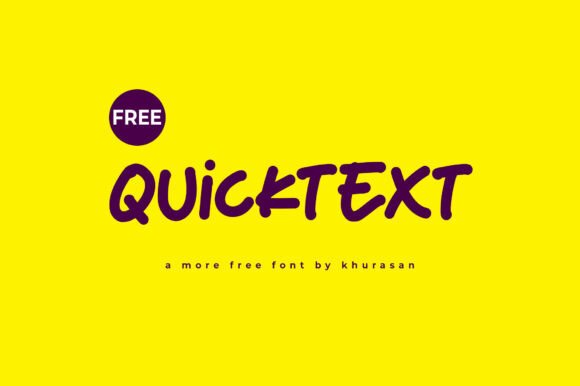
If you’re a crafter, Etsy seller, or printable designer who lives by the mantra “every detail matters,” then Quicktext is the kind of font that quietly elevates your entire product line. It’s not just another freebie—it’s a thoughtfully designed display typeface with soft curves, balanced proportions, and a gentle charm that reads as both modern and approachable. Whether you're laser-cutting wooden tags, printing boutique candle labels, or designing digital wedding invites, Quicktext delivers clarity without sacrificing personality.
What makes Quicktext stand out isn’t flashiness—it’s quiet confidence. Its letterforms are clean but never sterile, rounded but never childish. The lowercase ‘a’, ‘g’, and ‘e’ have subtle open counters, which helps maintain legibility even at small sizes (think 8–10 pt on product tags or 12 pt on greeting card headers). Uppercase letters hold strong presence without overwhelming—perfect for signage, wall art, or welcome boards where visual impact matters more than dense text.
Real-World Uses for Your Physical & Digital Products
You don’t need to be a graphic designer to get great results with Quicktext. Here’s how I use it across my own shop and client work:
- Candle and soap labels: Paired with a crisp sans serif for ingredients or scent notes, Quicktext shines as the brand name—soft enough for lavender fields, confident enough for blackberry mint.
- Wedding stationery: Use it for “Mr. & Mrs.” on foil-stamped escort cards or “Welcome” on chalkboard-style welcome signs. It feels intentional—not trendy, not dated.
- Seasonal printables: Halloween treat bags, Easter egg labels, or Christmas market tags gain instant warmth when Quicktext headlines the design.
- SVG files for Cricut & Silhouette: The outlines are smooth and well-spaced—no jagged joins or overlapping paths. I’ve cut it cleanly down to 0.75" tall on vinyl stickers with zero issues.
- Mugs, tote bags, and apparel: Because it’s a display font—not meant for body copy—it works beautifully as a single-line phrase (“Hello, Sunshine”, “Made With Love”, “Good Vibes Only”) that holds up in screen printing and heat transfer.
Readability & Production Tips You’ll Actually Use
Quicktext isn’t built for paragraphs—but that’s its strength. Reserve it for short, high-impact phrases where tone and recognition matter most. For example: your shop name on packaging, the title of a planner page, or the headline on a printable quote poster. When scaling it for cutting machines, keep these practical notes in mind:
- Avoid going smaller than 0.5" height for vinyl stickers unless you’re using a high-resolution cutter and testing first.
- For printed greeting cards or invitations, set tracking (letter spacing) to +10–+20 for better airflow—especially if printing on textured paper.
- In mockups, preview Quicktext at actual size: what looks lovely at 200% zoom may feel cramped at 100%. I always check final files at 100% before sending to print.
Smart Pairings That Keep Your Brand Cohesive
Quicktext plays well with others—especially when you’re building a consistent visual language across products. My go-to pairings:
- With a friendly sans serif (like Montserrat or Poppins): Use Quicktext for headlines and the sans for body text, pricing, or care instructions. This combo keeps things light, legible, and scalable across labels, websites, and social graphics.
- With a delicate script or handwritten font: Try Quicktext as the main title (“Emma & James”) and a flowing script for the date or location on wedding invites. The contrast feels intentional—not chaotic.
- With a classic serif (like Playfair Display or Lora): Great for book covers, boutique packaging, or vintage-inspired wall art where you want sophistication with a touch of playfulness.
Licensing, Formats, and What’s Included
As a small shop owner, I always double-check licensing before adding any font to my toolkit—and Quicktext is clearly marked as a freebie, licensed for commercial use. That means you can use it in physical products (stickers, mugs, apparel), digital downloads (printables, Canva templates), SVG designs, client work, and even resale items—as long as you’re not redistributing the font file itself.
The download includes standard OpenType (.otf) and TrueType (.ttf) formats—both work flawlessly in Cricut Design Space, Silhouette Studio, Adobe Creative Cloud, and free tools like Canva and Google Fonts (if self-hosted). While Quicktext doesn’t include swashes or stylistic alternates, its clean base design means fewer variables to manage across projects—ideal when consistency matters more than decorative flourishes.
It supports basic Latin characters (A–Z, numbers, common punctuation), making it reliable for English-language products, shop names, and seasonal phrases. If your shop serves multilingual customers, verify character coverage before using it for non-English product lines—but for most crafters selling in US, UK, Canada, and Australia markets, it’s fully functional.
Why This Font Fits Your Workflow—Not Just Your Aesthetic
Let’s be honest: not every cute font survives real-world production. Some look lovely on-screen but break apart when cut, blur when printed small, or feel too fragile next to bold product photography. Quicktext avoids those pitfalls. Its stroke weight is even, its spacing is generous, and its personality stays intact whether it’s laser-etched onto wood or screen-printed on canvas.
That reliability translates directly into customer perception. A hand-poured soy candle with a clean, warm label in Quicktext reads as thoughtful—not generic. A printable planner bundle with cohesive headings in Quicktext feels curated—not assembled. Even your Etsy banner or Instagram story highlights benefit from that same quiet polish.
And because it’s a free font, there’s no hesitation in testing it across multiple product types before committing. Try it on a batch of holiday gift tags, then scale it up for a farmhouse-style wall sign. See how it behaves with your printer, your cutter, your favorite paper stock. You’ll likely find yourself returning to Quicktext again and again—not because it’s trendy, but because it simply works.